Full Arches
Replace a full row of teeth with a fixed implant-supported solution.
Learn more
When you’re missing most or all of your teeth, eating becomes difficult. Talking feels off. You might find yourself smiling less. These are real problems that affect daily life. At Homer Watson Dental in Kitchener, we provide dental implants that can help restore function to your mouth.



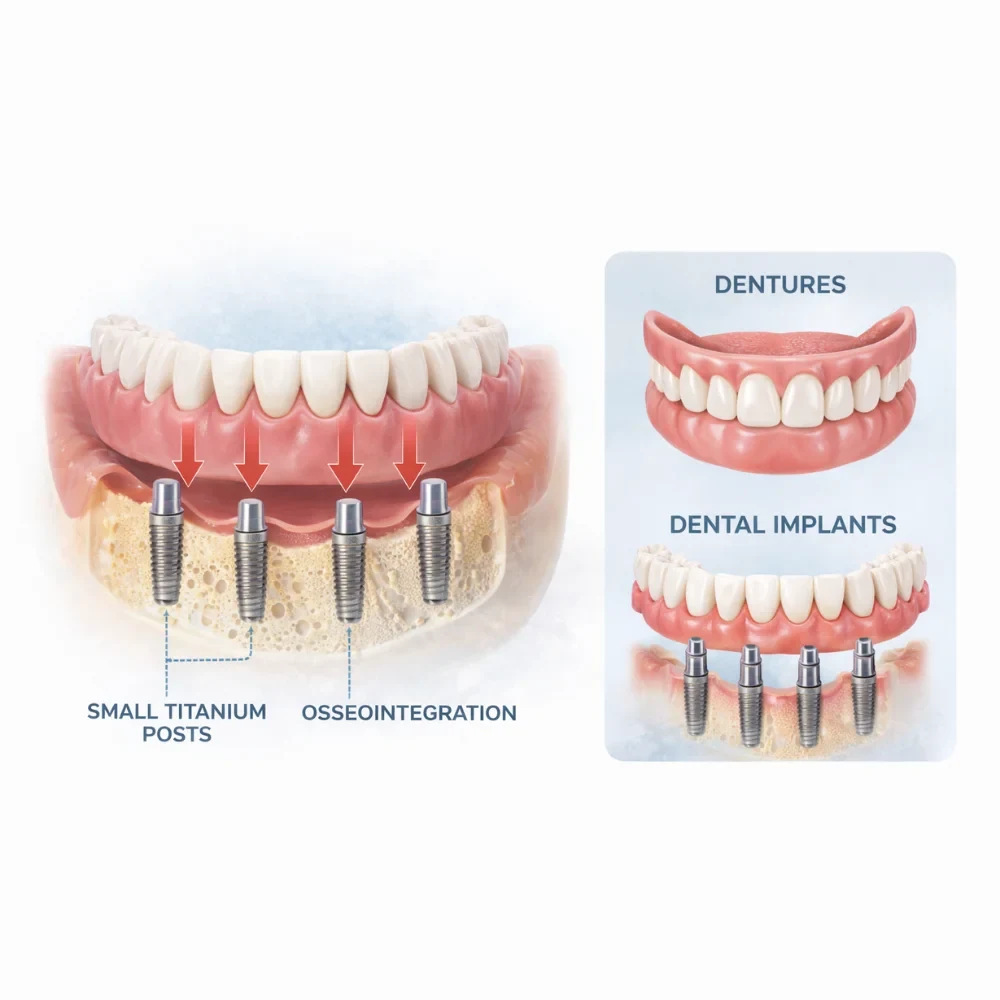
A dental implant is a small titanium post that takes the place of a missing tooth root. It sits in your jawbone, where it acts as an anchor. On top of that anchor goes a replacement tooth, a bridge, or a full set of teeth, depending on how many teeth you are missing.
The reason implants hold so well comes down to biology. Titanium is biocompatible, which means your body accepts it. Over a few months, the bone grows around the post and locks it in place. Dentists call this osseointegration. Once it happens, the implant has a stable foundation that can support a new tooth for many years.
Unlike a denture that rests on your gums or a bridge that leans on the teeth beside a gap, an implant stands on its own in the bone. It does not rely on nearby teeth for support — and that is what makes it feel and function close to a natural tooth.
Dental implants are not a single treatment. They are a family of solutions that scale to how many teeth you have lost. At Homer Watson Dental on Pearson Street in Kitchener, we look at your mouth first, then talk through which option fits. Here is a plain-language overview of the three main paths.
Missing one tooth? One post goes into the jaw and a custom crown is attached on top, shaped and shaded to blend in. Unlike a traditional bridge, the neighbouring teeth are left untouched, so more healthy tooth structure stays intact.
When several teeth in a row are missing, a few well-placed implants can support a bridge that spans the gap. Two implants might hold a bridge across three or four missing teeth — fixed teeth that stay put, without replacing each tooth one at a time.
For patients missing most or all of their teeth in a jaw, four to six implants support a complete set of fixed teeth — an All-on-4-style approach that gives loose-denture wearers teeth that stay in place.
Full-arch treatment has its own timeline, candidacy details, and care routine, so we cover it in depth on a separate page. If you think you may be missing enough teeth to need a whole arch replaced, learn more on our full arches in Kitchener page, where we walk through how the treatment works, who it suits, and what to expect step by step.
Implants are one of several ways to replace missing teeth. Traditional bridges and removable dentures also have their place, and they can be the right choice in some situations. Here is how implants tend to compare at a high level, so you can weigh the options with your dentist.
None of this means implants are automatically the best fit for everyone. Dentures can be a practical choice for some patients, and a bridge may make sense in certain cases. The right answer depends on your mouth, your health, and your goals, which is exactly what a consultation is for.
Most adults who are missing one or more teeth can be considered for implants, but a few things matter for a good outcome. We check each of these during your first visit at our Kitchener office. None of them automatically disqualify you — they are simply important to share so we can plan safely, and age on its own is rarely the deciding factor.
Every case is a little different, but most implant treatment follows the same general path. This is a high-level view, not a step-by-step surgical guide. The number of visits and the overall length depend on how many teeth are being replaced and whether any preparation, like grafting, is needed first.
We examine your mouth, take X-rays or a scan, and talk through your options. If an implant is a good fit, we plan exactly where it will go.
The implant post is positioned in the jaw where the missing tooth root used to be.
A healing period, often a few months, lets the bone integrate with the post and build a solid foundation.
Once the foundation is solid, the crown, bridge, or full arch is attached and adjusted so your bite feels comfortable.
One of the things patients appreciate about implants is that day-to-day care is simple — you look after them much like natural teeth. Brush twice a day with a soft-bristled brush, clean between the teeth with floss, small brushes, or a water flosser, and keep up with regular checkups and cleanings at our Kitchener office. A few habits help your results stay stable over the years.
It can be tempting to leave a gap alone, especially if it is toward the back of the mouth where it does not show. But missing teeth tend to cause knock-on effects over time. The teeth next to a gap can drift into the empty space, which changes your bite, and the tooth above or below the gap may start to move too. These shifts happen slowly, so many people do not notice until the changes are harder to manage.
There is also the bone to think about. Without a tooth root stimulating it, the bone in that area gradually shrinks, which is one reason acting sooner can keep your options simpler later. Chewing is affected as well — when teeth are missing, some foods become harder to eat, nudging people toward softer, less varied diets. Replacing missing teeth helps you keep eating comfortably and protects the teeth you still have.
Cost varies with the work involved — a single-tooth implant is a smaller treatment than a multi-tooth bridge or a full arch, and factors like whether bone grafting is needed and the type of restoration also affect the total. We go over the full picture during your consultation and put it in writing, so there are no surprises. Homer Watson Dental accepts the Canada Dental Care Plan (CDCP), helps you understand how it and other dental insurance may apply, and talks through payment options to make treatment easier to manage.
Homer Watson Dental is at 15 Pearson Street in Kitchener, just off Homer Watson Boulevard and easy to reach from Highway 401. Patients come to us from Forest Heights, Doon, Stanley Park, Country Hills, and neighbourhoods across the city and the wider Waterloo Region.
Whether you are missing one tooth or thinking about replacing a full arch, the first step is a conversation. We will look at your mouth, answer your questions, and help you understand which implant option, if any, fits your situation. There is no pressure at a consultation, just clear information so you can decide what is right for you. Contact us at 226-270-6311 or book online to get started.
These answers are general information, not a substitute for an exam. Your dentist will give you advice specific to your mouth, your health history, and your goals.
Not always. Implants suit many people, but bone volume, gum health, general health, and habits like smoking all play a part. In some cases a bridge or a denture may be a better fit. A consultation with an exam and imaging is how we sort out what makes sense for you.
It depends on how many teeth are being replaced and whether any preparation is needed first. Because the bone needs time to integrate with the implant, the overall process often spans a few months from consultation to final restoration. A single-tooth case is generally shorter than a larger one.
The restoration on top of an implant is custom made to match the shape, size, and shade of your other teeth, and the bite is adjusted so chewing feels comfortable. Most patients find the result blends in well with the rest of their smile.
It scales with how many teeth are missing — one post for a single tooth, a few implants to support a bridge across a section, or four to six for a full arch. We recommend the right option after examining your mouth.
Replace a full row of teeth with a fixed implant-supported solution.
Learn moreReady to book your Dental Implants consultation?
New patients welcome. CDCP accepted. Book online in under a minute, or call us directly.