iTero Intraoral Scanner
Digital impressions without trays or putty.
Learn more
Think about the last time you felt something stuck between your teeth. That annoying bit of food that your tongue keeps finding. You try to ignore it, but there it is again. Now imagine that feeling lasting for days, weeks, or months because tiny bits of plaque are building up where your toothbrush can’t quite reach.
That’s what happens without regular dental cleanings. The stuff that builds up isn’t just annoying. It turns into problems that cost more time and money to fix later.
At Homer Watson Dental, we’re located at , 15 Pearson Street in Kitchener, right in the southeast part of the city near Homer Watson Boulevard and Bleams Road. If you’re driving from the Doon area or anywhere along Homer Watson, you can find us easily in the newer medical building at that corner.



Let’s be real — nobody wakes up excited to go to the dentist. Some people think their teeth feel fine, so why bother? Others had a bad experience years ago and never went back. Money worries keep some folks away, and plenty of people just keep meaning to book but never get around to it.
Here’s what actually happens when you skip cleanings. Your mouth has bacteria living in it right now — that’s normal. But these bacteria love the same foods you do, and when they eat they make acid that sits on your teeth and slowly eats away the hard outer layer called enamel. Your toothbrush does a good job on most surfaces, but everyone’s toothbrush misses spots. The bacteria set up camp there and build a hard, crusty layer called tartar that brushing can’t remove. Left long enough, delaying care can lead to the need for emergency dental treatment or more complex procedures.
A regular cleaning is the cheapest, most comfortable dental appointment you’ll ever have — and it’s the one that keeps the expensive, uncomfortable ones from ever being needed.
A cleaning removes the tartar your toothbrush can’t. It shouldn’t hurt if your teeth and gums are in decent shape — though if it’s been a while, your gums may be tender or bleed a little because the bacteria under the tartar have been irritating them. Once everything is cleaned off, your gums can heal.
The hygienist works one section at a time, using special tools and a small mirror to scrape tartar off each tooth. You might hear some scraping sounds — that’s normal.
A water tool sprays and rinses away everything that’s been removed, keeping the area clean as they go.
A gritty paste that feels like sand buffs away surface stains and leaves your teeth smooth.
The dentist comes in for a 10–15 minute check of every tooth, your gums, and the soft tissues of your mouth.
After your teeth are clean, the dentist checks everything — catching small problems while they’re still small and cheap to fix.
Holes where acid has eaten through the enamel. Caught early, a small cavity may need only a filling instead of a root canal or crown.
Healthy gums are pink and firm. Red, puffy or bleeding gums signal gingivitis — reversible now, but it becomes bone-destroying periodontitis if ignored.
Your tongue, cheeks, palate and throat are examined for anything unusual. Most checks are clear, but this is how early concerns are found.
Periodontitis — advanced gum disease — loosens the bone that holds your teeth and is linked to heart disease and diabetes, so those gum checks matter. For alignment concerns, patients may also be referred for orthodontic treatment such as Invisalign or braces.
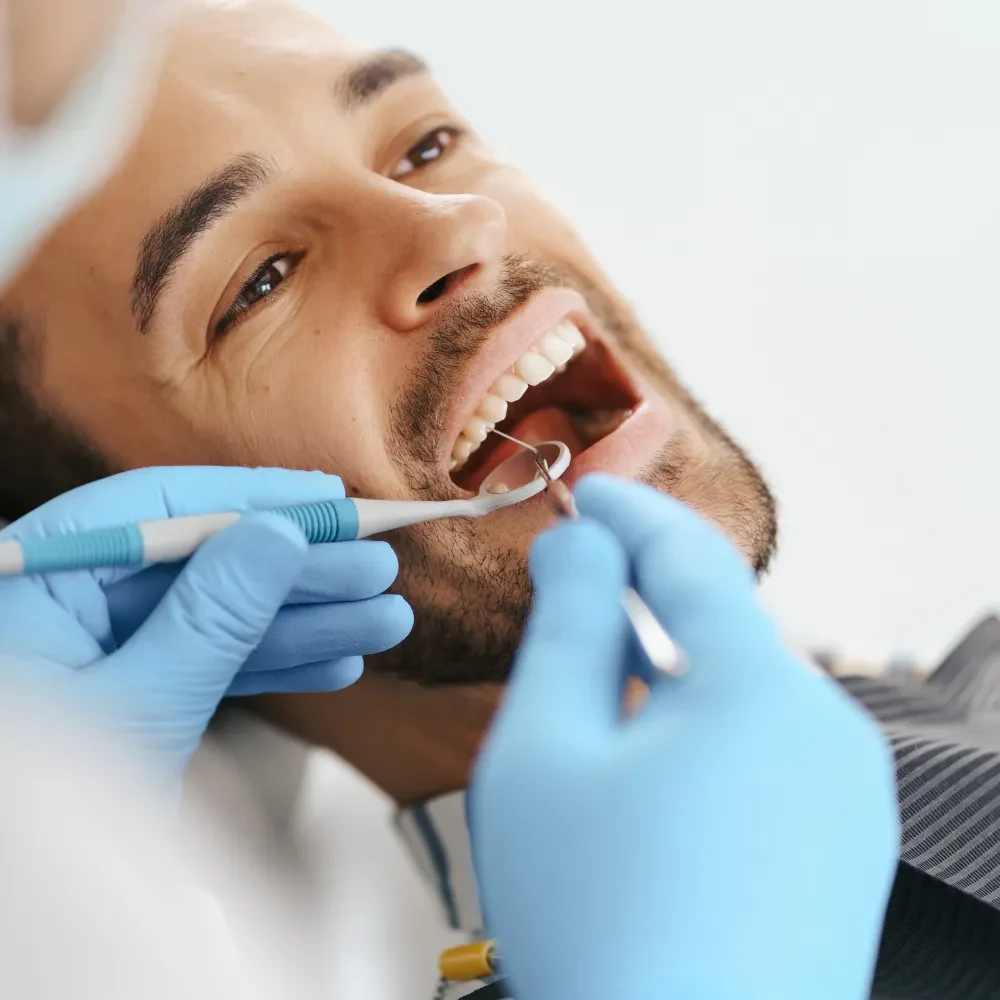
If the exam turns up an issue, we always explain what it is and walk you through your options — you decide what makes sense for you.
We numb the tooth, remove the decay, and fill the hole with a tooth-coloured material. Most fillings take under an hour.
A dental crown caps the whole tooth to protect it, usually over two visits.
A root canal cleans out the infected nerve and seals the tooth — it actually stops the pain of the infection.
Scaling and root planing removes tartar below the gum line, followed by more frequent cleanings to keep it from returning.
Sometimes a tooth can’t be saved. Think of your teeth like bricks in a wall — when one goes missing, the others shift, the tooth above drifts down into the gap, your bite changes, and your jaw joint can start to ache. Dental restorations put that structure back.
Dental implants are one way to fill the gap: a small post is placed in your jawbone to act as a tooth root, and once it heals a crown is attached on top that looks and works like a natural tooth. When the underlying bone has shrunk away, a bone graft can rebuild a solid foundation first. For patients in Forest Heights and Stanley Park who’ve been missing teeth for a while it can sound like a lot of steps, but each one builds on the last — giving you back the ability to chew, speak clearly, and smile without worrying.
Most people should have their teeth cleaned and checked every six months — that’s about how long it takes for tartar to build up enough to cause problems, and it lets us catch small issues early.
You see us twice a year — that’s two hours out of 8,760. The other 8,758 are up to you, and what you do at home matters most.
Most plans cover two cleanings and exams a year at 100% — insurers would rather pay for prevention than expensive treatment later. Without insurance, the cost of a cleaning and exam depends on how much buildup there is. Homer Watson Dental works with most plans and accepts CDCP; tell us your coverage when you book and we’ll let you know what you’ll owe, and ask about payment plans for larger treatments. Prevention always wins on price: a routine cleaning costs a fraction of the filling, crown, root canal or implant it helps you avoid — and enamel, once gone, never grows back.
You want a clinic that’s easy to reach, explains things in plain language, and fits your schedule. Our location at 15 Pearson Street is a few minutes from Doon, Forest Heights and Pioneer Park, with parking right at the newer medical building on the corner of Homer Watson Boulevard, close to Bleams Road. Coming from downtown Kitchener, take King Street East toward Highway 8 and turn south on Homer Watson; from Cambridge or the south end, Homer Watson runs right through the area. We show you exactly what we see — where a cavity is, why your gums bleed — without the jargon, and we offer sedation dentistry for a more comfortable visit.
If your teeth and gums are healthy, no — you may feel some pressure or scraping, but not pain. If it’s been years since your last visit, your gums may be tender and bleed a little as they heal.
Yes. If we froze anything you may want to wait until the numbness wears off, but otherwise you’re good to go.
Every six months for most people. If you have gum disease, diabetes or you smoke, we may suggest every three or four months.
The further a problem progresses, the more time and money it takes to fix — a cleaning, then a filling, then a crown, then a root canal, then an implant. Your teeth can’t heal themselves, so early is always cheaper.
Yes — we welcome new patients of all ages, work with most insurance plans, and accept CDCP.
If you can’t remember your last cleaning, or it’s been more than six months, now’s a good time to book. A regular schedule is the single best thing you can do for your teeth — contact Homer Watson Dental at 15 Pearson Street, Kitchener, ON N2C 0C5 to schedule your cleaning and exam. We’re here to keep your teeth healthy, one cleaning at a time.
Digital impressions without trays or putty.
Learn moreGentle, modern cleaning that removes plaque biofilm.
Learn moreProtective coatings to prevent cavities on back teeth.
Learn moreIn-office fluoride applications to strengthen enamel and reduce cavity risk.
Learn moreReady to book your Dental Clinic Services consultation?
New patients welcome. CDCP accepted. Book online in under a minute, or call us directly.